
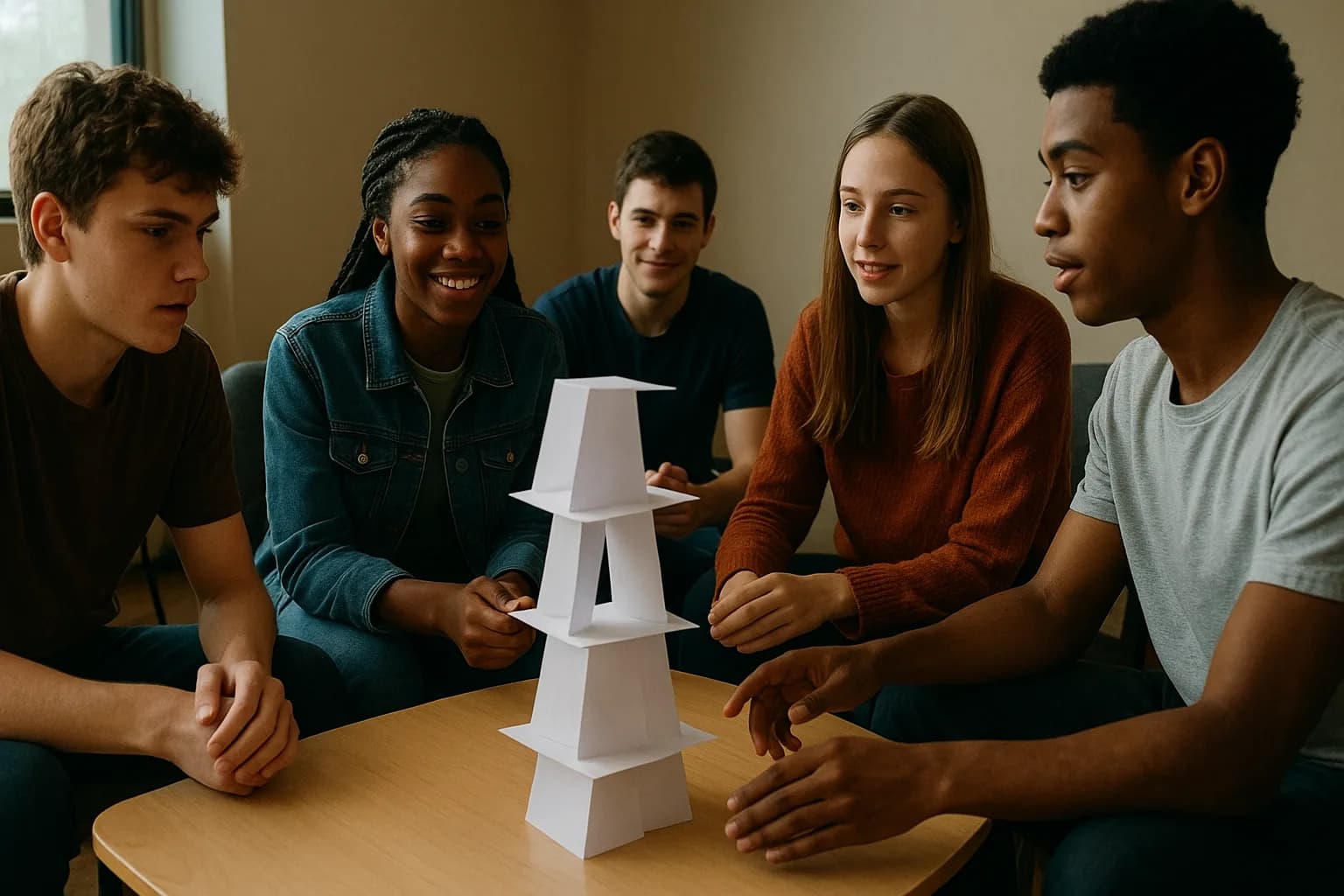
Rain has closed the oval, another group is using the hall, and your youth group has a room full of chairs. The evening can still include a game. Choose activities that use ideas and teamwork rather than speed or space.
These six games can be played around tables or in a seated circle. Before you start, check the room's permitted capacity, leave exits and walkways clear, and put bags somewhere people won't trip over them. Don't squeeze in extra players simply to reach a suggested group size.
Explain each game aloud and show an example. Offer a way to join without writing, drawing or speaking in front of everyone, and keep the volume suitable for the room.
1 Tabletop tower challenge
Group: 4–16, in teams of 2–4. Time: 8–10 minutes. Equipment: Ten sheets of scrap paper per team and a clear table.
Give each team the same amount of paper. Their challenge is to build a freestanding tower using only those sheets. Folding, rolling and tearing are allowed; tape, glue and leaning against a wall are not.
Allow one minute to plan and four minutes to build. Call time, ask everyone to take their hands away, then see which towers stand for ten seconds. Compare heights only after checking that the structures stand independently.
Invite teams to explain one thing they changed while building. Keep all structures on the table and choose roles together, including planner or tester for anyone who would rather not handle the paper.
2 Draw from directions
Group: 4–12, in pairs. Time: 7–9 minutes. Equipment: Paper and pens.
Each person draws a simple arrangement of shapes without showing their partner. One partner describes their drawing while the other tries to reproduce it. For example: “Draw a large circle in the middle, then a small square above it.”
Allow questions, but keep the original hidden until two minutes have passed. Compare pictures, swap roles and try again. Enjoy the differences without scoring artistic skill.
For a version without drawing, describe an imaginary room and ask the partner to repeat where the objects belong. Nobody needs to wear a blindfold or close their eyes.
3 Mystery object questions
Group: 4–12. Time: 5–7 minutes. Equipment: None.
Think of a familiar object, such as an umbrella. The group can ask up to ten questions that you can answer with yes, no or sometimes. Let people discuss a question together before asking it.
After the tenth question, invite one shared guess and reveal the answer. Give volunteers a turn choosing the next object. Start with broad categories such as household objects or things found at school.
If guessing is difficult, offer a clue rather than stretching the round indefinitely. Avoid using a person's belongings or appearance as the mystery item.
4 Silent sorting desk
Group: 4–16, in teams of 2–4. Time: 6–8 minutes. Equipment: Identical sets of paper cards, each labelled with a different everyday object.
Prepare eight cards per team: book, bicycle, spoon, tent, apple, shoe, clock and backpack. Ask each team to arrange its cards from smallest to largest without speaking. Gestures are allowed, and anyone may move a card within comfortable reach.
After two minutes, let teams explain their order. A tiny tent or giant book could change the answer, so agree on ordinary examples instead of declaring every difference wrong.
Try a second sort, such as most to least useful on a picnic. If silent communication excludes someone, allow conversation; the interesting part is agreeing on an order.
5 Mini quiz with shared answers
Group: 4–20, in teams of 2–4. Time: 8–10 minutes. Equipment: Paper, pens and six prepared questions.
Mix question types so the quiz doesn't depend on one person's specialist knowledge. For a starter set, ask teams to name the planet known as the Red Planet, the shape with eight sides and the name for a young frog before it grows legs. The answers are Mars, octagon and tadpole. Add three questions that suit your group and check their answers beforehand.
Read each question twice, allow about thirty seconds to discuss, and have teams record one answer. Reveal the answers together at the end. Accept spoken answers privately if writing is difficult.
Keep teams involved throughout. There is no need to eliminate anyone or make incorrect answers a source of embarrassment.
6 Invent a useful object
Group: 4–16, in teams of 2–4. Time: 8–10 minutes. Equipment: Paper and pens, optional.
Give each team a harmless inconvenience: wet shoes, tangled headphones or losing your place in a book. Ask them to invent an object that would help, including one sensible feature and one ridiculous extra.
Allow four minutes to design, then invite each team to give a thirty-second explanation. A sketch is welcome but not necessary. People can share the speaking or ask a leader to read their idea.
Finish by asking which feature they would actually find useful. There doesn't need to be a winning invention.
End with time to reset
Allow a couple of minutes to collect paper, restore chairs and settle before the next part of the evening. A small room works best when the activity has a clear ending and everyone knows what happens next.
For another session, explore Fervr's youth group games collection, choosing activities that suit your venue and group.